
Hamilton County Probate Records Scope
Probate in Hamilton County is not handled by a separate surrogate or orphans court. The research map identifies the probate page name as the Probate Division of the Circuit and Superior Courts. Local rules place estate, guardianship, trust, and mental-health probate case work inside the Hamilton Circuit and Superior Court system, while the Hamilton County Clerk keeps records for estates and guardianship among other county-level court cases.
Probate records can include wills, petitions, inventories, accountings, orders, letters, fiduciary instructions, creditor notices, guardianship reports, trust filings, and mental-health case entries. A will alone is not the full probate file. A guardianship file may involve a protected person, guardian, physician report, inventory, or biennial report. A trust matter may include petition and order material. Mental-health records are especially sensitive and should not be treated as ordinary public records.
The county publishes its Hamilton County probate rules for estates, guardianships, and fiduciaries.
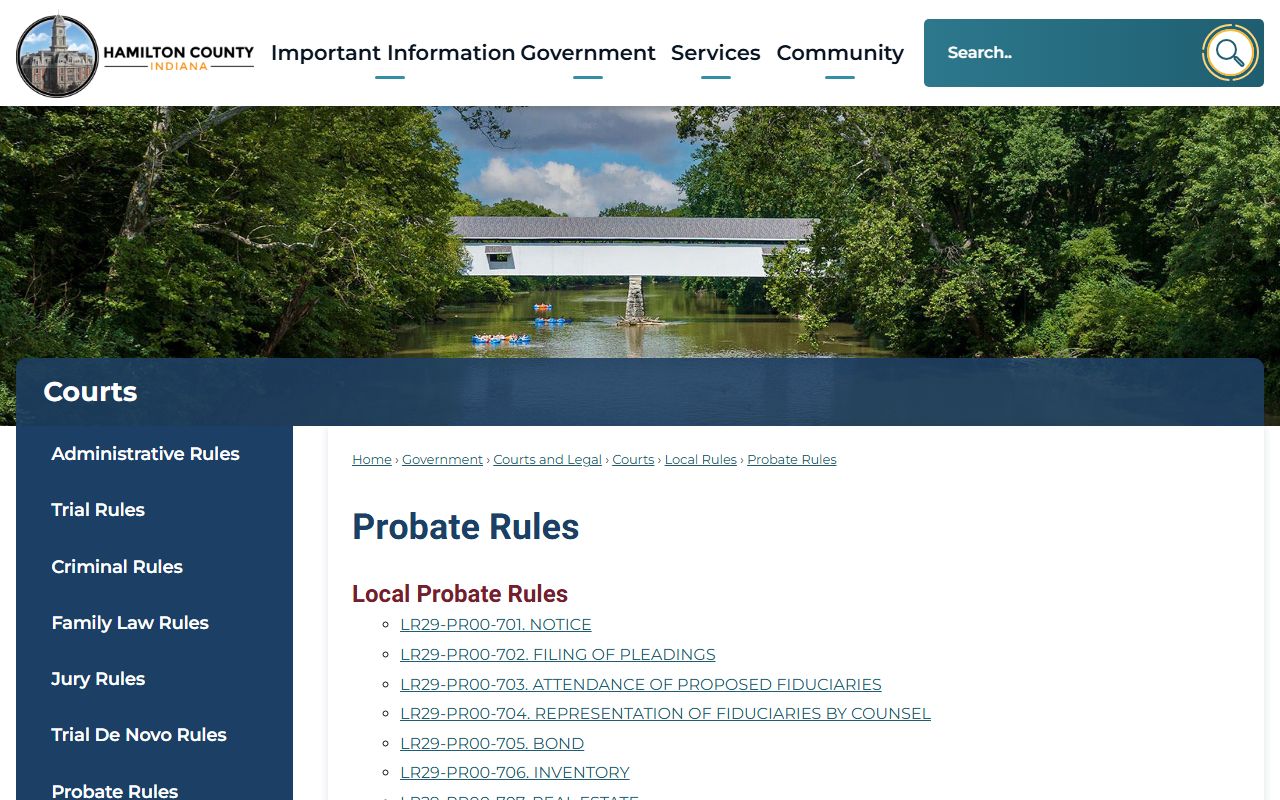
Those local rules explain the filing duties that shape many probate records, including inventories, accountings, fiduciary qualifications, and creditor notices.
Hamilton County Probate Terms
Probate terms can make a court record hard to read. The definitions below use plain language for common words that appear in estate and guardianship files. They do not decide anyone's rights in a case. They help identify what type of filing or court role may appear in a Hamilton County probate record.
- Testator
- A person who made a will.
- Executor
- A person named to carry out a will. Indiana records may also use personal representative.
- Intestate
- A death without a valid will controlling the estate.
- Guardianship
- A court case where a guardian is appointed for a minor or protected adult.
- Conservatorship
- A protective property-management concept. Hamilton County research more often uses guardianship language.
- Fiduciary
- A person with legal duties to act for another person or estate, such as a personal representative or guardian.
Search Hamilton County Probate Records
Public probate case information is searched through Indiana MyCase when the case is available to the public. Search by party, estate name, protected person name, or case number if known, and limit the search to Hamilton County when the filter is offered. MyCase is useful for case summaries, court assignment, chronological case events, and some public documents, but it is not the official court record. Official copies come from the court that maintains the case, which in Hamilton County means the Clerk for county-level court records.
- Start with MyCase and choose a party or case-number search.
- Use Hamilton County as the county filter when available, then review court, case type, filed date, and status.
- Check whether a public document link appears in the chronological case summary.
- If the document is not online, use the Clerk's Record Request page for estates, wills, or related probate copies.
- For in-person help, contact the Clerk's Office in Suite 106 at the Government and Judicial Center.
Note: Wills and estate documents are often not online, and Indiana public-records guidance says to request unavailable documents from the county clerk.
Hamilton County Probate Contacts
The local rules assign probate work across specific Superior Courts rather than a separate probate courthouse. Estate, guardianship, and trust case types are assigned to Superior Court 1, Superior Court 2, and/or Superior Court 3 on an even and random basis. Mental-health case types are assigned to Superior Court 1 and Superior Court 3 equally or as the judges agree. Court files and copy requests still run through the Clerk.
Hamilton County Clerk
1 Hamilton County Square, Suite 106
Noblesville, IN 46060
317-776-9629
Court filing hours: 8 a.m.-4 p.m. Monday-Friday
Probate Division of the Circuit and Superior Courts
1 Hamilton County Square
Noblesville, IN 46060
Court Administration: 317-776-8589
Local rules cover estate, guardianship, trust, and mental-health assignments.
Hamilton County Probate Fees
The official fee table separates estate, guardianship, trust, and mental-health case types. Fees are not the same as attorney fees, publication costs, service costs, or copy costs. The county also gives a special warning about small-estate affidavits: a small-estate affidavit is used if the estate does not exceed $100,000, and the county says not to file it with the courts.
| Case type or probate item | Fee or assignment rule |
|---|---|
| Estate supervised administration | $177 |
| Estate unsupervised administration | $177 |
| Estate miscellaneous: probate will or open safety deposit box | No charge |
| Guardianship | $177 |
| Guardianship miscellaneous | $177 |
| Trust | $177 |
| Mental health | $157 |
| Small-estate affidavit | Use if estate does not exceed $100,000; county says do not file with courts |
| Estate, guardianship, trust assignment | Superior Court 1, 2, and/or 3 evenly/randomly |
| Mental-health assignment | Superior Court 1 and Superior Court 3 equally or as judges agree |
Hamilton County Probate Forms
Hamilton County publishes probate forms and local court forms for fiduciaries, guardians, personal representatives, and related probate roles. The forms page includes personal representative instructions, guardian instructions, a guardian's guide, financial and investment certification, Clerk's certificate as to costs and claims, maximum fee guidelines, guardian ad litem forms, physician's report, biennial guardian report and order forms, release of funds, and attorney undertaking. These form names are useful search clues when a probate record has a docket entry that references a local form code.
The manifest assigned the county Probate Rules Forms page and the broader Court Forms page to Hamilton County probate records.
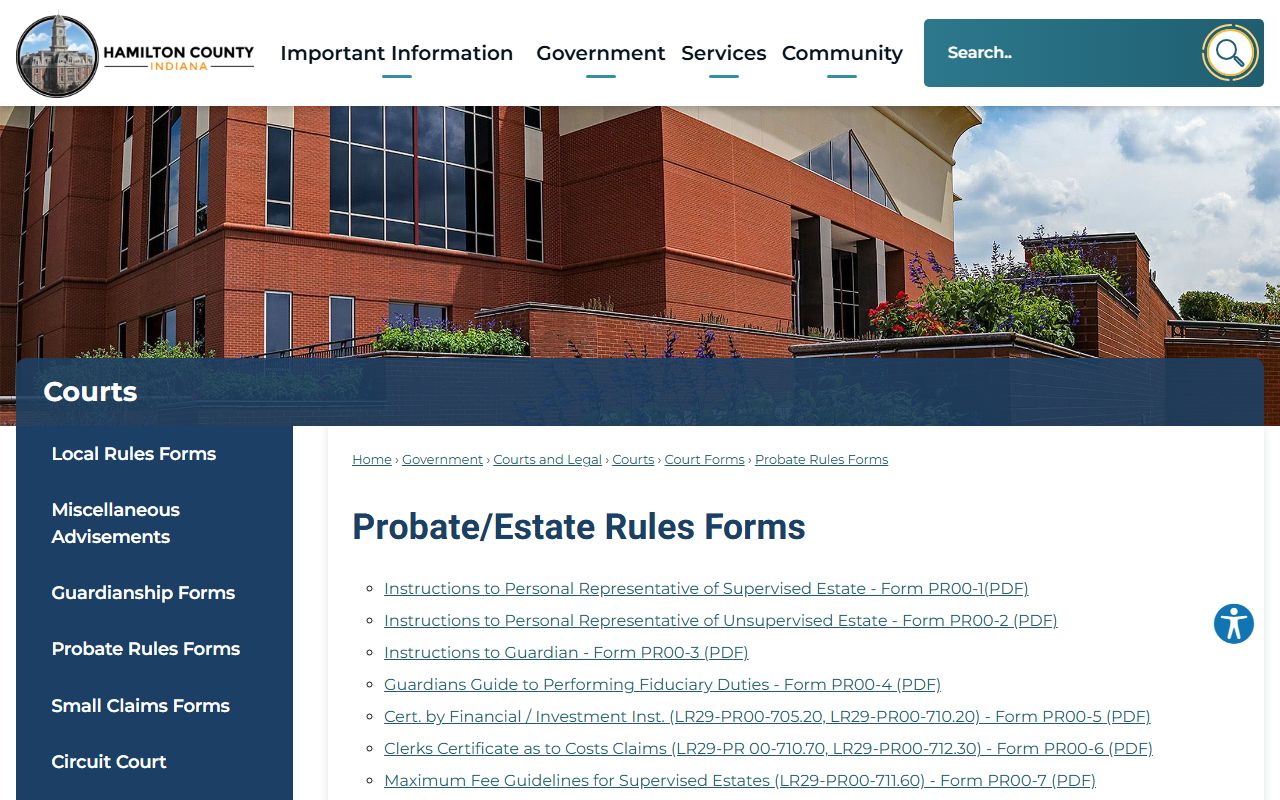
The probate forms page supports filings by personal representatives, guardians, guardian ad litem roles, and physicians in guardianship-related matters.
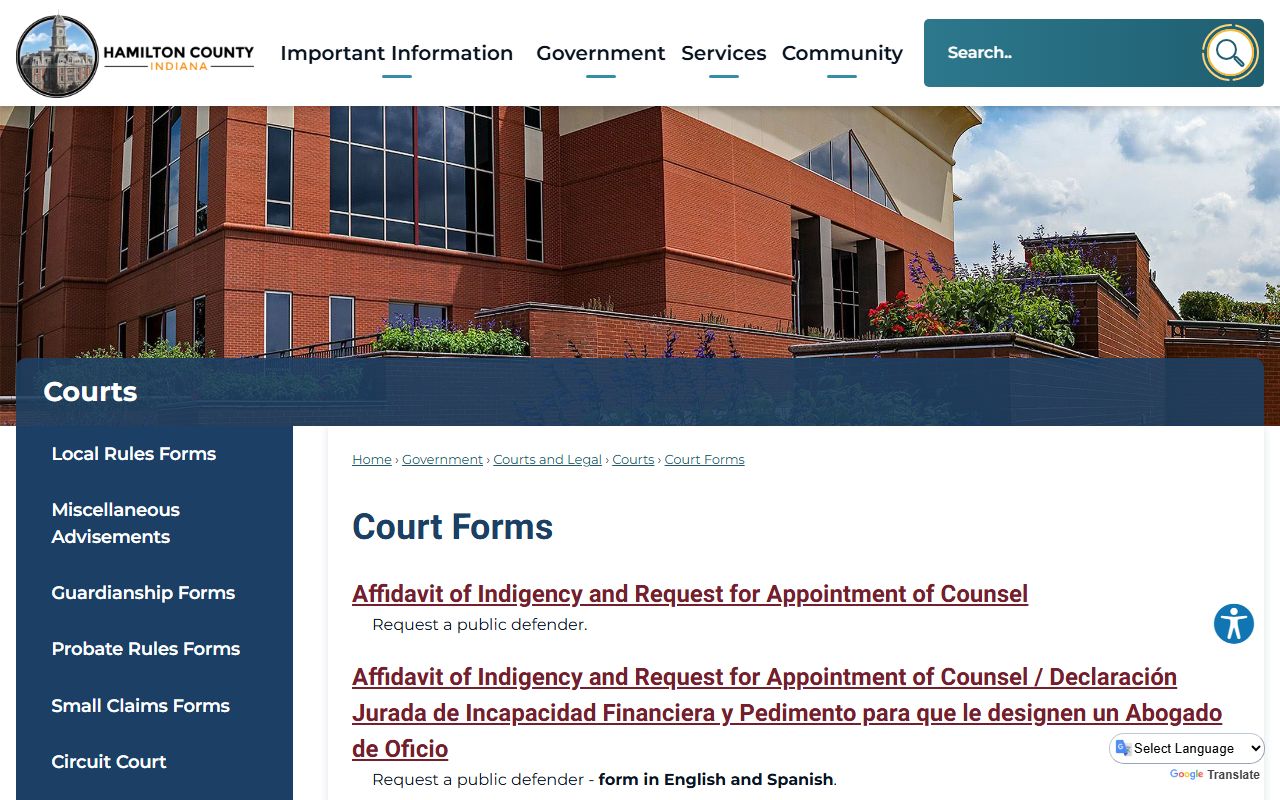
The broader court forms page also points users to guardianship, probate, small claims, local rules forms, and the small-estate affidavit note.
Hamilton County Probate Record Contents
Local probate rules explain several documents that may appear in a Hamilton County probate file. Notice of the opening of an estate must be sent by first-class U.S. mail to all reasonably ascertainable creditors, and certified mail with return receipt is recommended. Notice for a hearing on a petition to determine an estate insolvent must be served on interested parties, including the local representative of the Inheritance Tax Division of the Indiana Department of Revenue. Parties must prepare orders unless the court directs otherwise.
Every inventory and accounting in an estate or guardianship must be signed and verified by the fiduciary and signed by the attorney for the fiduciary. Pleadings must contain party or attorney contact information. Initial petitions to open an estate or guardianship must include the representative's or guardian's name, address, Social Security number under Access to Court Records Rule 5 handling, and phone number if the representative or guardian is a person. Instructions to the Personal Representative or Guardian must be filed when letters are ordered issued.
Those requirements mean a public probate docket can show more than a will filing. It may show that letters were issued, that an inventory deadline exists, that a creditor notice affidavit was filed, or that a guardian report is due. The docket entry may be public while the attached document is unavailable online or redacted. A researcher should treat MyCase as a locator and status tool, then use the Clerk's copy process for the official document when the record is public and available.
Hamilton County also uses probate forms with local form codes. PR00-1 and PR00-2 relate to supervised and unsupervised estate personal representative instructions. PR00-3 and PR00-4 relate to guardian instructions and the guardian's guide. PR00-10 is a physician's report, and PR00-11 and PR00-12 relate to biennial guardian reports and orders. Those labels can help explain docket entries that would otherwise look like short internal codes.
Restricted Hamilton County Probate Records
Probate records can include information that is public in part and restricted in part. Guardianship, mental health, Social Security numbers, minor information, medical information, protected financial details, and sealed material may be redacted or unavailable. Hamilton County's own probate rules build confidentiality into some filings by requiring Social Security numbers in initial estate or guardianship petitions in compliance with Access to Court Records Rule 5.
Timing rules also affect what appears in a public file. Supervised estate inventories are due within 60 days. Guardianship inventories are due within 90 days for permanent guardians and 30 days for temporary guardians. The rules state that no personal representative or guardian of an estate may proceed without counsel unless the court approves, and Indiana-resident fiduciaries must appear before the court to qualify. These requirements can create docket entries even when the underlying private details are not open to the public.
Mental-health case types are assigned under the probate local rules, but they should be handled as restricted records. Minor guardianship and protected-person information may also be withheld or narrowed by court rule. If MyCase does not show a document, that absence does not prove the record does not exist. It may mean the document is not public online, is excluded from public access, or must be requested from the Clerk for review under the applicable access rules.